 Skip to content
Cashew Processing Flow Chart: Complete Equipment Guide for Factory Setup
Understanding the cashew processing flow chart is critical for anyone planning to establish a processing facility or upgrade existing operations. This visual roadmap shows how raw cashew nuts transform into premium kernels through a series of interconnected stages. More importantly, it reveals where specific processing equipment fits into the workflow and why each machine matters for overall efficiency.
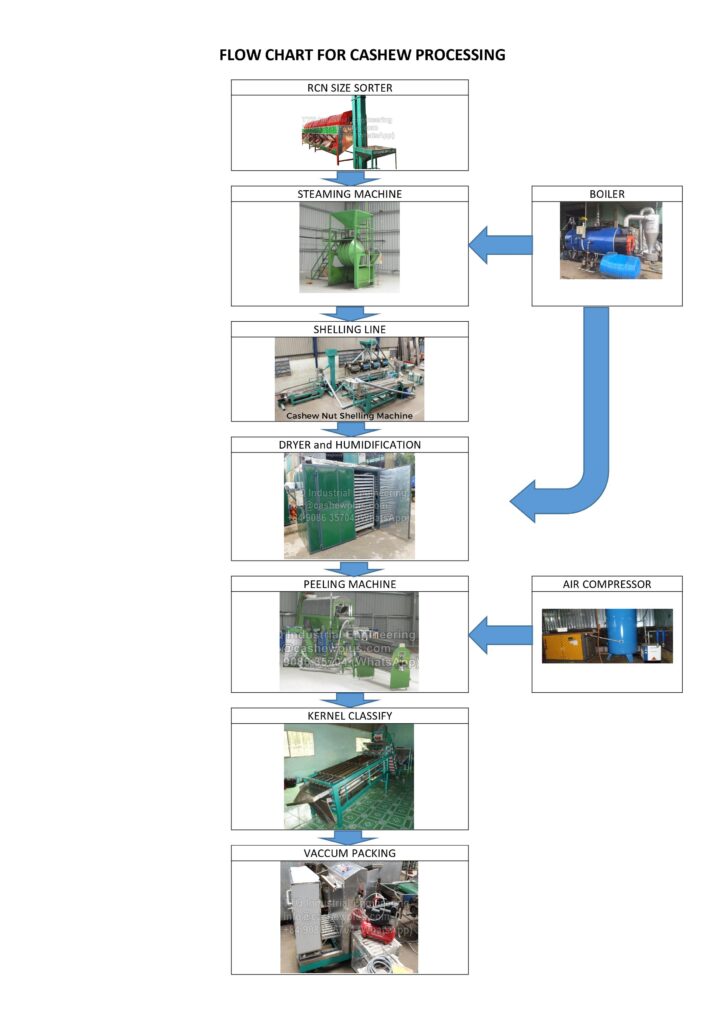
The Complete Cashew Processing Flow Chart
The cashew processing flow follows a logical sequence where each stage prepares material for the next. Missing or poorly executed steps create problems downstream that no amount of quality equipment can fix later.
Stage 1: Raw Material Reception and Storage
Flow Position: Entry point
Input: Raw cashew nuts from farms or traders
Output: Cleaned, stored raw nuts ready for processing
The flow chart begins when raw cashew nuts arrive at your facility. These nuts typically contain 8-10% moisture and come mixed with debris from harvesting and transportation.
Equipment Required:
- Moisture meters for incoming quality assessment
- Ventilated storage silos or warehouse space
- Material handling equipment (conveyors, elevators, or loaders)
Critical Parameters: Maintain storage conditions at 7-8% moisture to prevent mold growth while avoiding over-drying that makes shells too brittle. Proper storage capacity matters—you need at least 15-30 days of raw material buffer for continuous operations.
Stage 2: Cleaning and Preliminary Grading
Flow Position: First processing stage
Input: Raw nuts with debris
Output: Clean, size-sorted raw nuts
Raw cashews contain leaves, twigs, stones, and undersized or damaged nuts that must be removed before further processing.
Automatic Raw Cashew Nut Grading Machine:
This machine uses vibrating screens with multiple deck levels. Raw nuts feed onto the top screen and cascade downward, passing through progressively smaller openings. Each screen separates a specific size range.
Capacity range: 500-2,000 kg/h depending on model
Power requirement: 2-5 HP
Benefits: Uniform sizing ensures consistent conditioning and shelling results
The cashew processing flow chart shows cleaning and grading as the first mechanical step because size uniformity directly affects all downstream processing. Try to shell mixed sizes together and you’ll either under-process large nuts or break small ones.
Stage 3: Conditioning (Steaming or Roasting)
Flow Position: Pre-treatment before shelling
Input: Cleaned, graded raw nuts
Output: Conditioned nuts with softened shells
Raw cashew shells are extremely hard. Conditioning weakens shell structure without damaging the kernel inside.
RCN Steaming Machine:
The preferred method in modern facilities, steaming exposes raw nuts to high-pressure steam (3-4 bar pressure) for 10-15 minutes. The steam penetrates the shell, softening it while partially liquefying the CNSL (cashew nut shell liquid) inside.
Typical specifications:
- Batch capacity: 200-500 kg
- Steaming cycle: 10-15 minutes
- Pressure: 3-4 bar
- Construction: Stainless steel pressure vessel
Why it matters in the flow: Proper conditioning reduces shelling machine wear, improves kernel recovery rates from 75% to 85-90%, and makes CNSL collection easier. The flow chart positions this before shelling because under-conditioned nuts jam shelling equipment while over-conditioned nuts become sticky and difficult to handle.
Alternative: Roasting drums heat raw nuts to 180-200°C for 8-12 minutes. More common in African facilities, this method completely removes CNSL through burning but requires careful temperature control.
Stage 4: Shelling (Cutting)
Flow Position: Core processing stage
Input: Conditioned whole nuts
Output: Shelled kernels with testa (skin) attached
Shelling represents the most critical step in the cashew processing flow chart. This is where the hard outer shell separates from the valuable kernel—and where poor equipment causes the most losses.
Automatic Cashew Nut Shelling Machine (Cutting Type):
Modern shelling machines use calibrated cutting blades that make two precise cuts in the shell without penetrating to kernel depth. The shell splits and falls away, leaving the kernel intact.
TTQ Cutting Machine Specifications:
- Single-head capacity: 60-80 kg/h
- Multi-head capacity: Up to 400+ kg/h
- Whole kernel recovery: 85-90%
- Power: 2-3 HP per head
- Blade adjustment: Manual or automatic based on nut size
Flow integration point: The shelling stage needs input from grading (uniform sizes) and conditioning (proper shell softening). It feeds into drying, so shelling capacity must match dryer capacity to prevent bottlenecks.
CNSL collection: Good shelling machines incorporate CNSL collection trays. This toxic liquid has commercial value for resins and friction materials. Collecting it turns a waste disposal problem into a revenue stream.
Stage 5: Kernel Drying
Flow Position: Post-shelling treatment
Input: Wet shelled kernels (8-12% moisture)
Output: Dried kernels (3-4% moisture)
Freshly shelled kernels contain too much moisture for effective peeling. The drying stage in the cashew processing flow chart brings moisture down to the precise level needed for the next stage.
Cashew Kernel Steam Dryer Room:
These are typically batch dryers where kernels spread on trays in a heated chamber. Hot air circulates at 60-70°C, gradually reducing moisture content over 8-12 hours.
Dryer sizing: Match capacity to shelling output. A facility shelling 300 kg/h over an 8-hour shift produces 2,400 kg wet kernels daily. Your dryer needs 2,500-3,000 kg capacity to handle daily production.
Why precise moisture matters: The flow chart shows drying feeding into humidification because the target moisture (3-4%) is actually too low for peeling. This seems contradictory until you understand the next stage.
Stage 6: Kernel Humidification (Borma)
Flow Position: Pre-peeling conditioning
Input: Dried kernels (3-4% moisture)
Output: Conditioned kernels (5-6% surface moisture)
This might be the most misunderstood stage in the cashew processing flow chart. After carefully drying kernels, you now add moisture back—but only to the surface.
Cashew Kernel Humidification Chamber:
These chambers expose dried kernels to steam or fine water spray for 30-90 seconds. The brief treatment raises surface moisture to 5-6% while the kernel core remains at 3-4%.
The science: This moisture gradient softens the thin testa (skin) covering the kernel while the kernel itself stays firm. Try to peel without this step and you’ll get poor skin removal plus high breakage.
Timing in the flow: The processing flow chart shows a 2-4 hour window between humidification and peeling. Process too quickly and surface moisture hasn’t penetrated enough. Wait too long and moisture redistributes throughout the kernel, losing your advantage.
Stage 7: Kernel Peeling (Testa Removal)
Flow Position: Quality refinement stage
Input: Conditioned kernels with skin
Output: Clean, peeled white kernels
The brown testa covering shelled kernels must be removed to produce the cream-colored cashews consumers expect. This delicate operation can make or break your quality grades.
Cashew Kernel Peeling Machine:
Modern peeling machines use a two-stage approach combining mechanical and pneumatic action. TTQ’s peeling machines represent current industry best practice.
Stage one: Mechanical peeling
- Rotating drums lined with soft abrasive surfaces gently scrub kernels
- Brush-type agitators loosen the testa through controlled friction
- Kernel residence time: 2-3 minutes in the peeling chamber
Stage two: Pneumatic peeling
- High-pressure compressed air (6-8 bar) blasts loosened testa away
- Multiple air jets positioned along conveyor path
- Air separates testa fragments while kernels continue forward
TTQ Peeling Machine Capacity:
- 1-head: 120-180 kg/h
- 2-head: 240-300 kg/h
- 3-head: 360-420 kg/h
- 4-head: 420-480 kg/h
Air compressor requirements:
- 1-head: 30 HP compressor
- 2-head: 50 HP compressor
- 3-head: 75 HP compressor
- 4-head: 100 HP compressor
Results: Properly configured peeling machines achieve 80-85% whole kernel recovery with complete testa removal. The integrated vibrating screen automatically separates any remaining testa fragments from finished kernels.
Flow chart positioning: Peeling comes after humidification and before grading because kernel moisture condition directly affects peeling success. Feed improperly conditioned kernels and breakage rates jump to 20-30%.
Stage 8: Kernel Grading and Sorting
Flow Position: Quality classification
Input: Peeled white kernels (mixed sizes and grades)
Output: Size-sorted, defect-free kernels by grade
International standards define 26+ cashew grades from W180 (largest wholes) through W450 and various broken grades. Accurate grading determines product value and market access.
Cashew Kernel Grading Machine:
Primary grading uses vibrating screens with standard opening sizes. Kernels cascade over multiple screen decks, falling through openings matching their size category.
Capacity: 300-800 kg/h depending on number of decks
Grades separated: Typically 4-6 size categories per pass
Power: 3-5 HP for vibration motors
Broken Kernel Grading Machine:
Separate equipment handles pieces, splits, and broken kernels, classifying them into commercial broken grades (LWP, SWP, BB, etc.). These still have value but sell at lower prices than wholes.
Advanced sorting: Cashew Nut Color Sorter
Optical color sorters use high-resolution cameras and sensors to identify and reject kernels with:
- Dark spots or discoloration
- Remaining testa patches
- Insect damage
- Foreign material
Capacity: 500-1,500 kg/h
Accuracy: 99%+ defect removal
Investment: ₹15-25 lakh
The cashew processing flow chart shows grading after peeling because peeled kernels reveal defects (spots, breaks, discoloration) not visible on unpeeled kernels. Some facilities do preliminary size grading before peeling, then final quality grading after.
Stage 9: Roasting (Optional Value Addition)
Flow Position: Optional processing branch
Input: Graded white kernels
Output: Roasted cashews ready for packaging
Many processors sell raw kernels to traders. Adding a roasting stage captures additional margin by moving closer to retail products.
Cashew Nut Roasting Machine:
Drum roasters mixing kernels with salt (1:1 or 1:2 ratio) in rotating heated drums remain the preferred method for even roasting.
Batch specifications:
- Capacity: 50 kg per batch
- Roasting time: 10-15 minutes
- Temperature: 160-180°C
- Fuel: Gas-powered infrared burners (2-3 kg gas/hour)
The salt acts as a heat transfer medium, preventing direct contact with hot drum surfaces that cause burn spots. After roasting, vibrating screens automatically separate salt from kernels for reuse.
Flow chart note: Roasting appears as a branch in the flow chart because it’s optional. Facilities producing raw kernels skip this stage entirely, while those targeting retail markets include it.
Stage 10: Packaging
Flow Position: Final stage
Input: Processed kernels (raw or roasted)
Output: Market-ready packages
Proper packaging protects kernels from moisture, oxidation, and contamination during distribution and storage.
Cashew Kernel Vacuum Packing Line:
Vacuum packaging remains the choice for premium whole kernels destined for export. The process removes air from packages, preventing oxidation while compressing contents for efficient shipping.
System components:
- Automatic weighing scales (accuracy ±1-2 grams)
- Vacuum chamber (single or double chamber configurations)
- Sealing mechanism
- Conveyor integration
Throughput: 60-120 packages per hour depending on package size
Package sizes: Typically 5 kg, 10 kg, or 12.5 kg for bulk export; 100-500 grams for retail
Alternative: Nitrogen flushing systems replace air with inert nitrogen, preventing oxidation without vacuum compression. Better for products where visual presentation matters more than density.
The cashew processing flow chart ends here with finished packaged products ready for warehouse storage and distribution.
.
Equipment Integration and Flow Optimization
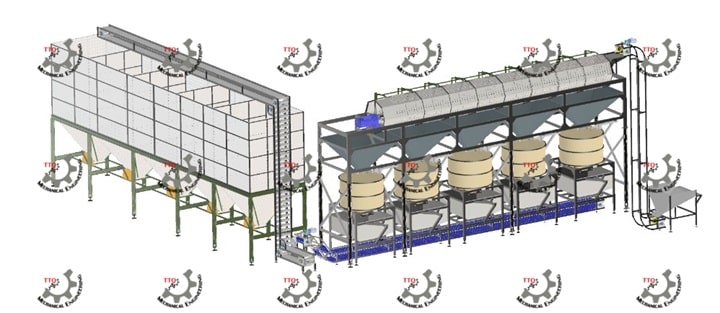
The cashew processing flow chart isn’t just a list of sequential steps—it’s an interconnected system where each stage depends on the previous one performing correctly.
Capacity Balancing
The most common mistake in facility planning is installing equipment with mismatched capacities. Your processing flow runs at the speed of your slowest stage.
Example capacity calculation:
If you install:
- Shelling: 300 kg/h capacity
- Drying: 2,000 kg batch capacity (8 hours = 250 kg/h)
- Peeling: 240 kg/h capacity
Your effective processing rate becomes 240 kg/h—limited by peeling capacity. The shelling and drying equipment will operate below capacity, wasting investment.
Proper balancing: Design capacity at each stage should match within 10-20%. Allow slightly higher capacity at bottleneck stages (typically shelling and peeling) to accommodate process variations.
Buffer Points in the Flow
The processing flow chart should include buffer storage between stages to handle:
- Equipment maintenance or repairs
- Process variations (some stages faster than others)
- Quality holds for inspection
- Shift changes
Typical buffer capacities:
- After shelling: 1-2 hours of dryer capacity
- After drying: 4-8 hours of peeling capacity
- After peeling: 4-8 hours of grading capacity
Material Flow and Handling
Efficient facility layout minimizes material handling between stages shown in the flow chart:
Linear flow: Raw material storage → Cleaning → Conditioning → Shelling → Drying → Humidification → Peeling → Grading → Roasting → Packaging → Finished goods storage
Conveyor systems connect stages automatically, reducing labor and contamination risk. Budget 8-12% of total equipment cost for material handling.
Utility Requirements
The processing flow chart implies utility demands at each stage:
Compressed air: Critical for peeling machines (largest demand), plus automated controls throughout
Steam/heat: Conditioning, drying, humidification, roasting
Electricity: All motors, controls, lighting
Water: Cleaning, steam generation, facility hygiene
Size utility systems for peak simultaneous demand, not total connected load.
Selecting Equipment for Your Flow Chart
When building or upgrading a cashew processing facility, equipment selection should follow the flow chart systematically.
Scale Considerations
Small-scale operations (200-500 kg raw nuts/day):
- Semi-automatic equipment at each stage
- Batch processing with manual material transfer
- 8-12 workers
- Total equipment investment: ₹25-50 lakh
Medium-scale operations (500-1,500 kg/day):
- Mix of automatic and semi-automatic equipment
- Partial conveyor integration
- 15-30 workers
- Equipment investment: ₹75 lakh – ₹2 crore
Large-scale operations (2,000+ kg/day):
- Fully automatic processing lines
- Complete integration with central controls
- 30-60 workers (mostly sorting/packaging)
- Equipment investment: ₹3-10 crore
Quality vs. Cost Trade-offs
Not all equipment performs equally even at the same stated capacity. Key differentiators in the flow chart equipment include:
Shelling machines:
- Whole kernel recovery: 75-80% (basic) vs. 85-90% (quality)
- 10% difference in recovery equals ₹100-150/kg additional value
Peeling machines:
- Complete testa removal: 90-95% (basic) vs. 98%+ (quality)
- Broken rate: 15-20% vs. 8-10%
Grading/sorting:
- Manual sorting only vs. automatic color sorters
- Accuracy: 85-90% vs. 99%+
Pay more for quality equipment at bottleneck stages (shelling, peeling) where they directly impact yield and product grades.
TTQ Co. Ltd. Complete Flow Solutions
TTQ provides equipment for every stage shown in the cashew processing flow chart—from individual machines to complete turnkey installations.
Our approach:
- Site assessment to determine optimal flow layout
- Capacity balancing across all processing stages
- Equipment selection matching your quality and budget targets
- Installation, commissioning, and operator training
- Ongoing technical support and spare parts
Geographic experience: We’ve installed processing lines following this flow chart across India, Vietnam, Nigeria, Tanzania, Brazil, and other major cashew regions. Each installation adapts the basic flow chart to local conditions, available utilities, and specific product requirements.
Whether you’re establishing a new facility or upgrading existing operations, understanding the cashew processing flow chart helps you make informed decisions about equipment investment priorities and facility layout.
The cashew processing flow chart represents decades of industry evolution toward efficient, quality-focused processing. Each stage builds on the previous one, with specific equipment requirements that can’t be skipped or substituted without consequences.
Success in cashew processing requires more than just buying machines—it demands understanding how those machines fit into the complete flow, where capacity bottlenecks occur, and how process variations at one stage affect downstream operations.
Partner with experienced equipment suppliers like TTQ Co. Ltd. who understand the complete flow chart and can design integrated solutions rather than just selling individual machines. The difference shows up in your operational efficiency, product quality, and ultimately your profitability.
CONTACT FORM
We understand selecting the ideal cashew processing machinery is a crucial decision for your business. Filling our simple contact form will help us grasp your requirements accurately and suggest customized solutions for long-term efficiency gains. Our team will get in touch shortly to initiate the best pricing and features discussion for your upgrade needs.

CONTACT FORM
We understand selecting the ideal cashew processing machinery is a crucial decision for your business. Filling our simple contact form will help us grasp your requirements accurately and suggest customized solutions for long-term efficiency gains. Our team will get in touch shortly to initiate the best pricing and features discussion for your upgrade needs.